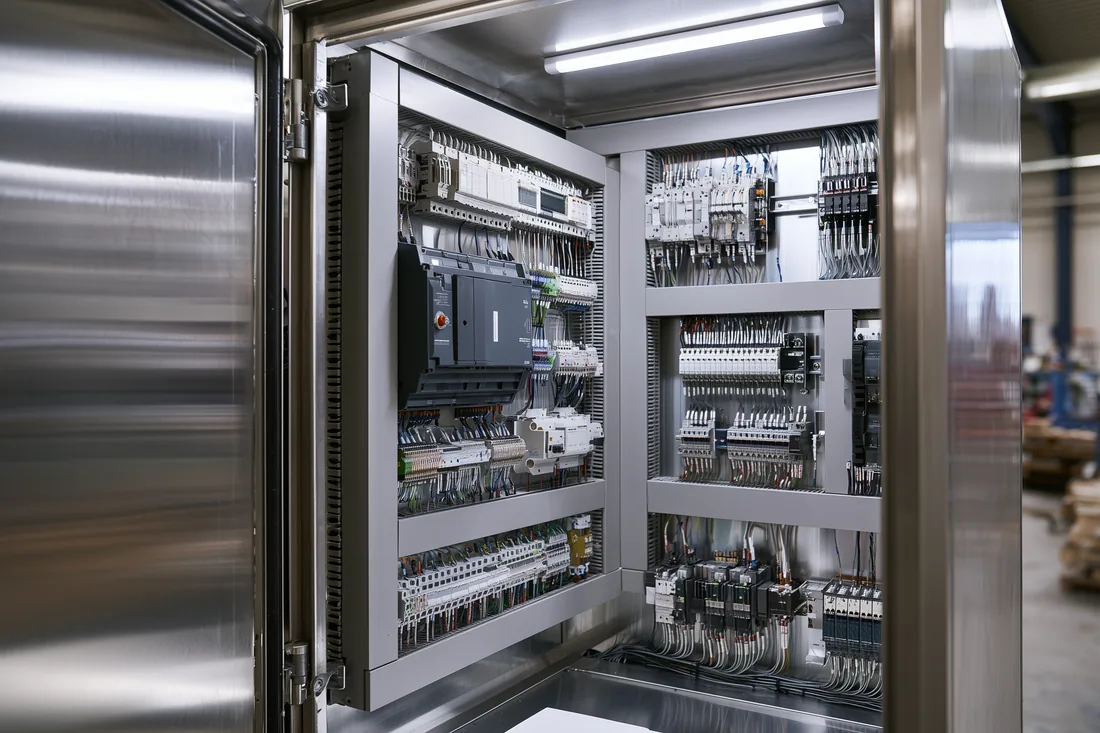
Discrete manufacturing depends on cells, robots and machines staying up, and on the changes made to keep them running being documented well enough that the next person doesn’t have to reverse-engineer them from scratch. Being independent and not tied to one platform is a real advantage on a floor that mixes Rockwell, Siemens and half a dozen OEM machine controllers, none of which were built to talk to each other by default.
The costliest faults are usually a stalled cell idling skilled labor around it, not a single blown component — a vision system that’s drifted out of tolerance, a robot program with an undocumented offset nobody remembers setting, or integration gaps between a new machine and the line it was dropped into. Test rigs and inspection stations carry a quieter version of the same problem: pass/fail logic written for one product run that nobody updates when the product changes, so good parts start failing for the wrong reason.
We get the cell running first, then integrate and document the fix properly, so the next fault, or the next engineer, doesn’t start from zero. None of this is exotic work. It’s the unglamorous discipline of naming what changed, why, and what it’s expected to do, so the same fault doesn’t get rediscovered from scratch by whoever’s on shift six months later.
- PLC & machine control
- Robots & automated cells
- Vision & test systems
- VFDs & motion control
- Line integration & data
- HMI / SCADA
- Machine device networks & CAN bus (CANopen, DeviceNet)
- Stalled cells idling skilled labor
- Mixed-vendor integration gaps
- Undocumented or one-off logic
- Poor production visibility
- Aging machine controls
Your Old PLC Is Dying. The Logic Inside It Is the Part You Can’t Reorder.
When you replace an unsupported controller, the hardware is the easy part; the process knowledge buried in the program is what you can lose.
Read →Who Do You Actually Call When the Control System Is Misbehaving?
The original equipment maker isn’t always the answer, and neither is an independent. Here’s how to tell which one your problem needs.
Read →Got a plant that isn't behaving?
Tell us what's giving you trouble. The first conversation is free, and you'll get a straight assessment.
Get in touch